AI Has A Scaling Problem
Only 20% of AI decision-makers believe their organization can scale AI initiatives, according to Forrester. This limitation matters because it hinders the potential benefits of AI.
Original reporting · forrester.com
Read “AI Has A Scaling Problem” at Forrester →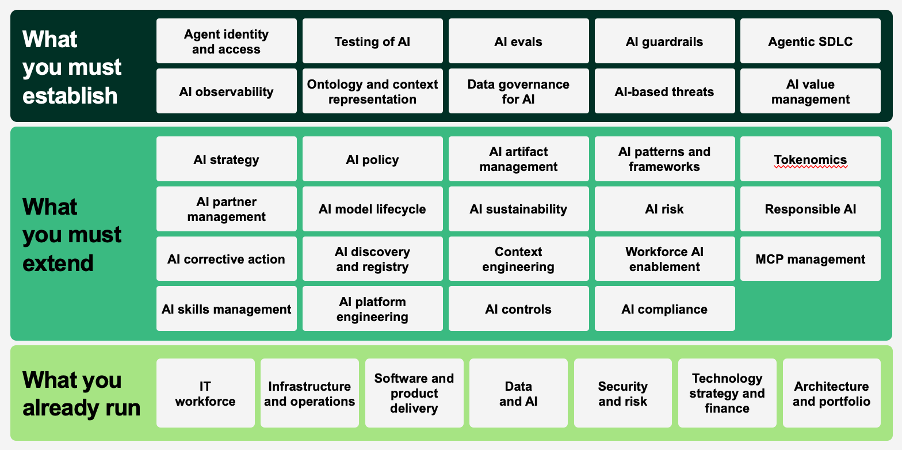
How this was written. Content Memory wrote this article with a language model from Forrester’s reporting (model: @cf/meta/llama-3.3-70b-instruct-fp8-fast); it describes that reporting rather than adding to it. The original, linked above, is the full story.
Key points from Forrester’s report
- Only 20% of AI decision-makers believe their organization has the technology to scale AI initiatives.
- High-readiness organizations are more likely to deploy multiple AI use cases and achieve end-to-end process improvements.
- The Technology AIQ framework will help organizations assess their readiness to support AI at scale.
- Establishing a foundation for future initiatives is crucial to scaling AI effectively.
- Organizations must evaluate their technology capabilities to identify areas for improvement.
Forrester's State Of AI Survey, 2026, reveals that while many organizations have implemented AI, few have the technology to scale these initiatives. Forrester reported that 82% of respondents have at least one generative AI application in production, and 77% have at least one agentic AI application. However, only a small percentage have successfully scaled AI at the business or enterprise level.
The challenge now is to make each successive AI initiative more efficient, cost-effective, and secure. According to Forrester, high-readiness organizations are more likely to deploy multiple AI use cases and achieve end-to-end process improvements.
Forrester introduced the concept of Technology AIQ at its Technology & Innovation Forum East, which aims to assess an organization's readiness to support AI at scale. This framework will be launched in January 2027 and will help organizations evaluate their technology environment.
Organizations that have successfully scaled AI have established a foundation for future initiatives, allowing them to build on existing capabilities. This approach enables teams to reuse existing infrastructure, data, and models, reducing duplication and increasing efficiency.
The Technology AIQ assessment evaluates an organization's technology capabilities across three layers: existing IT foundations, AI-specific capabilities, and extended capabilities. It examines observable practices that facilitate the delivery of AI initiatives, such as reusing tested connectors and applying established controls.
To scale AI effectively, organizations must establish a connected set of technology capabilities. Forrester recommends that technology leaders require their teams to identify what they will reuse from previous initiatives and what they will leave behind for future initiatives.
By adopting this approach, organizations can create a flywheel effect, where each initiative strengthens the capabilities of the next team. This enables organizations to overcome the scaling challenges and realize the full potential of AI.
Questions and answers
What is the main challenge facing organizations that have implemented AI?
The main challenge is scaling AI initiatives, with only 20% of AI decision-makers believing their organization has the necessary technology.
What is Technology AIQ?
Technology AIQ is a framework developed by Forrester to assess an organization's readiness to support AI at scale.
How can organizations overcome the scaling challenges of AI?
Organizations can overcome these challenges by establishing a connected set of technology capabilities and creating a flywheel effect, where each initiative strengthens the capabilities of the next team.