Forrester Says AI Bubble Not Bursting Yet
Forrester's AI Bubble Model indicates that a burst is not imminent, according to its latest report. The model analyzes supply pressure and demand absorption to predict the likelihood of an AI bubble burst.
Original reporting · forrester.com
Original: “The AI Bubble Isn’t Bursting Yet — Here’s What To Watch Using Our Model”
Read “The AI Bubble Isn’t Bursting Yet — Here’s What To Watch Using Our Model” at Forrester →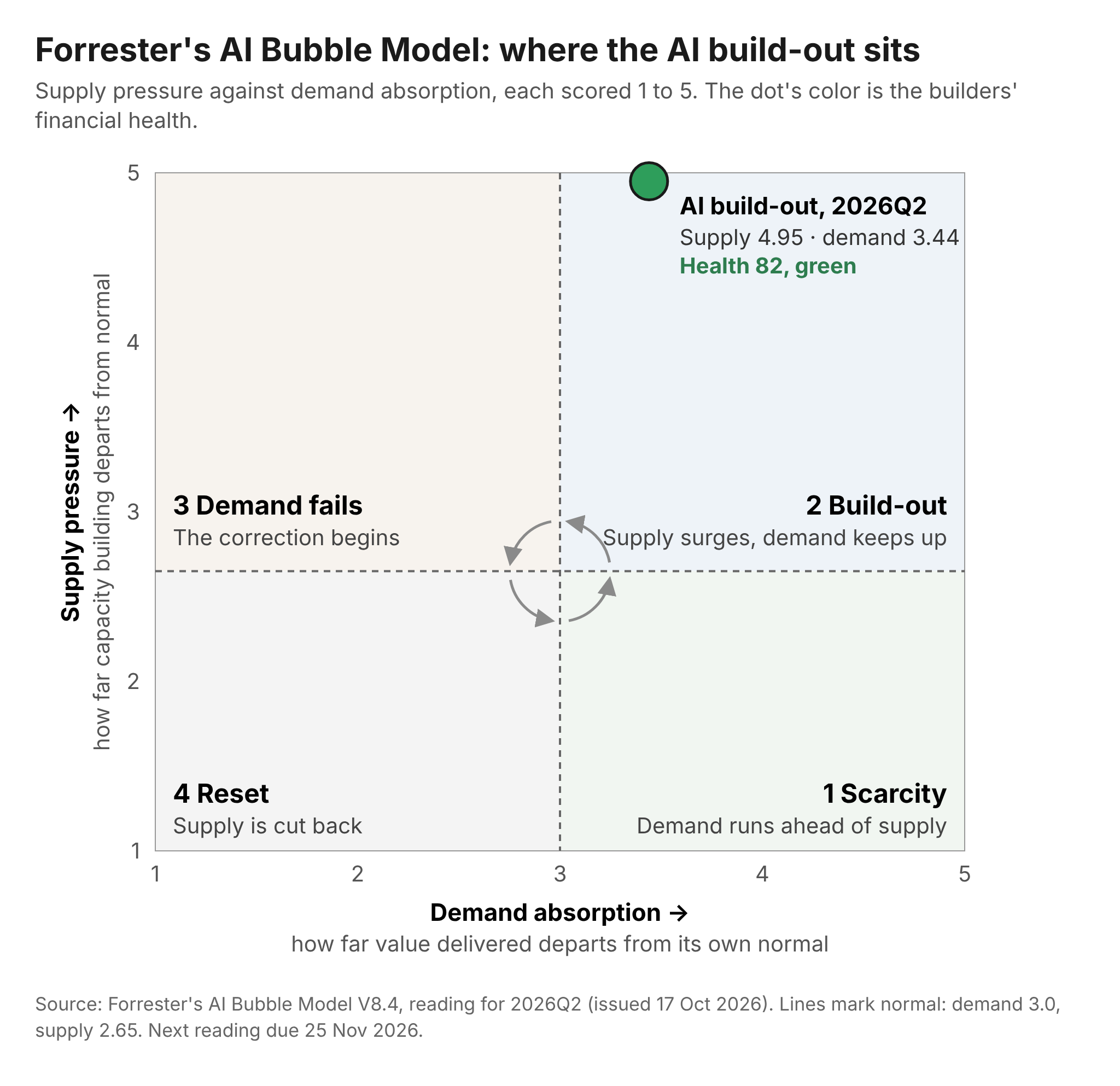
How this was written. Content Memory wrote this article with a language model from Forrester’s reporting (model: @cf/meta/llama-3.3-70b-instruct-fp8-fast); it describes that reporting rather than adding to it. The original, linked above, is the full story.
Key points from Forrester’s report
- Forrester's AI Bubble Model indicates that a burst is not imminent, but the health of the companies building AI compute infrastructure is a key factor to watch.
- The model tracks two key forces: supply pressure and demand absorption, and plots them against each other to predict the likelihood of a bubble burst.
- The health of the companies building AI compute infrastructure is scored based on six measures, including their filings and share prices.
- The AI build-out is starting to outrun the cash reserves of even the largest tech companies, with many relying on external funding sources to support their investments.
- Forrester's model will continue to track the health of the companies building AI compute infrastructure, including private companies like OpenAI and Anthropic.
Forrester has developed an AI Bubble Model to assess the risk of an AI bubble bursting, according to Forrester. The model uses publicly available financial data to track two key forces: supply pressure and demand absorption. Supply pressure measures the level of investment in AI compute infrastructure, while demand absorption measures the economic value delivered by AI.
The model plots these two forces against each other, resulting in four phases: scarcity, build-out, demand fails, and reset. As of the second quarter of 2026, supply pressure was extremely high, while demand absorption was relatively ordinary. This gap between supply and demand is a potential problem, but Forrester's model suggests that it is not yet critical.
The health of the companies building AI compute infrastructure is a key factor in determining the likelihood of a bubble burst, Forrester reported. The model scores the financial health of these companies based on six measures, including their filings and share prices. As of the second quarter of 2026, the nine companies tracked by Forrester scored 82 out of 100, indicating good health.
However, the health score has been declining, and Forrester's latest data refresh puts the score at 79.1. This decline is due in part to the increasing reliance of big tech companies on external funding sources, such as bonds and loans, to finance their AI build-out. For example, Amazon spent $77.3 billion on its build-out in the third quarter, while generating only $42.4 billion in operating cash.
Other companies, such as Alphabet and Microsoft, are also relying on external funding sources to support their AI investments. Meta, meanwhile, has filed for a $25 billion forward share sale and $12.5 billion of mandatory convertible preferred stock to help finance its build-out. These trends suggest that the AI build-out is starting to outrun the cash reserves of even the largest tech companies.
Forrester's AI Bubble Model will continue to track the health of the companies building AI compute infrastructure, including private companies like OpenAI and Anthropic. When these companies go public, they will be added to the model's basket of tracked companies. For now, the model suggests that while the AI bubble is not yet bursting, the health of the companies building AI compute infrastructure is a key factor to watch.
Questions and answers
What is Forrester's AI Bubble Model?
Forrester's AI Bubble Model is a tool that uses publicly available financial data to track the risk of an AI bubble bursting. It analyzes supply pressure and demand absorption to predict the likelihood of a bubble burst.
What are the two key forces tracked by the model?
The two key forces tracked by the model are supply pressure, which measures the level of investment in AI compute infrastructure, and demand absorption, which measures the economic value delivered by AI.
What does the model's health score indicate?
The model's health score indicates the financial health of the companies building AI compute infrastructure, based on six measures including their filings and share prices. A high score indicates good health, while a low score indicates poor health.