Salesforce Shares Lessons On Connecting Product Knowledge To AI
Salesforce Blog reported on lessons learned from using Data 360 to prepare product knowledge for AI agents, emphasizing content quality and testing. This approach helps ensure trustworthy AI responses.
Original reporting · salesforce.com
Original: “4 Data 360 Lessons for Connecting Product Knowledge to AI”
Read “4 Data 360 Lessons for Connecting Product Knowledge to AI” at Salesforce Blog →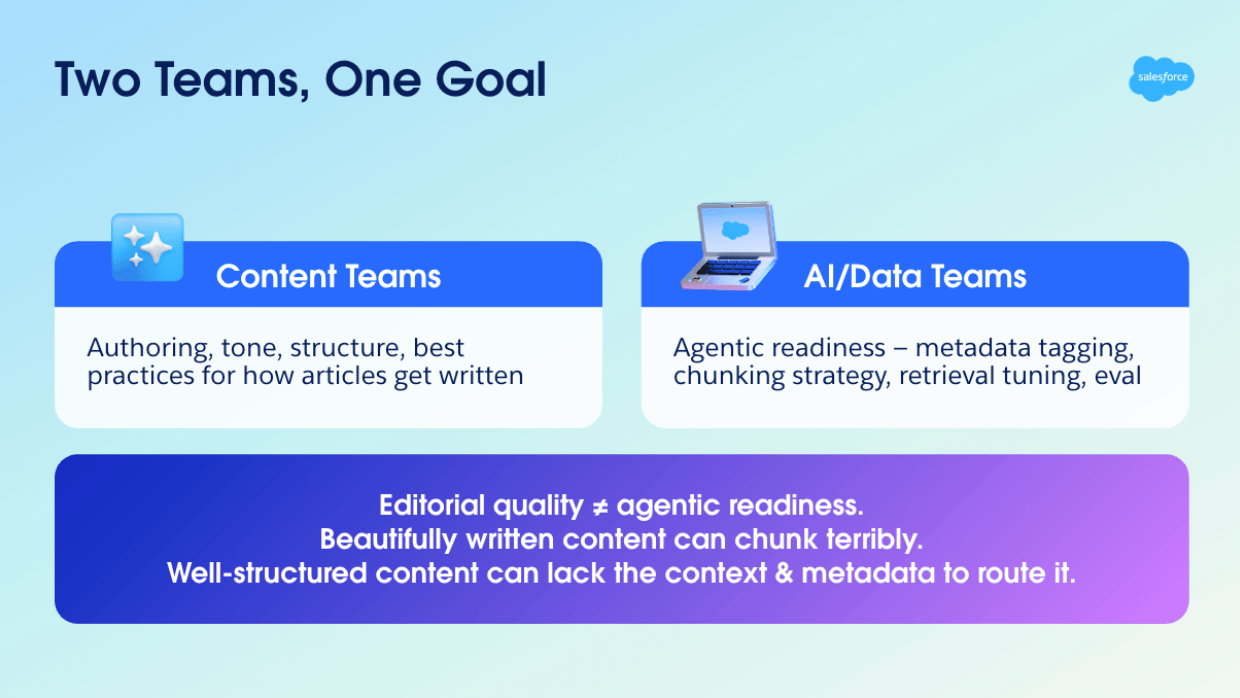
How this was written. Content Memory wrote this article with a language model from Salesforce Blog’s reporting (model: @cf/meta/llama-3.3-70b-instruct-fp8-fast); it describes that reporting rather than adding to it. The original, linked above, is the full story.
Key points from Salesforce Blog’s report
- Content quality is crucial for trustworthy AI agent responses, according to Salesforce Blog.
- Assessing existing content for 'fit, gap, and clash' is essential before indexing it.
- Defining 'good' answers using a golden data set and acceptance criteria helps evaluate agent performance.
- Both quantitative and qualitative testing methods are necessary to ensure accurate and helpful AI agent responses.
- Salesforce's approach to connecting product knowledge to AI has resulted in significant improvements in agent performance.
Salesforce is working to improve the trustworthiness of its AI agents' answers by connecting them to its own product knowledge content. According to Salesforce Blog, this process starts with preparing and organizing product knowledge using Data 360, which is then used by Agentforce to provide customer support.
The goal of this approach is to ensure that AI agents provide accurate and reliable responses to customer inquiries. Salesforce Blog reported that the quality of the content used to train AI agents is crucial, as it directly affects the standard of the agent's answers.
To achieve this, Salesforce follows a set of lessons learned from its own experience, including assessing content quality before building an agent and treating each adjustment as a hypothesis to be tested. The company also emphasizes the importance of defining what constitutes a 'good' answer and using both quantitative and qualitative methods to evaluate agent performance.
One key lesson is to assess existing content for 'fit, gap, and clash' before indexing it, which involves evaluating whether each article answers a real customer question, covers an issue that has not been addressed, or contradicts other content. Salesforce Blog noted that more content does not necessarily mean better coverage, and that a larger index can actually make an agent slower and more confused.
Salesforce's content and AI teams work together to prepare content for use by AI agents, with the content team responsible for authoring and the AI team responsible for making the content 'agent-ready'. The company uses a loop of hypothesizing, building, evaluating, and deploying changes to its agents, with a focus on testing and iteration.
The company also defines 'good' answers using a golden data set and acceptance criteria, which involves pairing utterances with validated expected answers and links to relevant articles. Both quantitative and qualitative testing methods are used to evaluate agent performance, including deterministic, semantic quality, and business outcomes testing.
Salesforce Blog reported that the combination of quantitative and qualitative testing helps to ensure that AI agents provide accurate and helpful responses to customer inquiries. The company's approach to connecting product knowledge to AI has resulted in significant improvements in agent performance, including a 92% resolution rate for questions on the Informatica help portal.
Questions and answers
What is the first step in preparing product knowledge for AI agents?
The first step is to assess existing content for 'fit, gap, and clash' before indexing it, according to Salesforce Blog.
How does Salesforce define 'good' answers for AI agents?
Salesforce defines 'good' answers using a golden data set and acceptance criteria, which involves pairing utterances with validated expected answers and links to relevant articles.
What is the importance of testing in evaluating AI agent performance?
Testing is crucial in evaluating AI agent performance, as it helps ensure that the agent provides accurate and helpful responses to customer inquiries, according to Salesforce Blog.


